


Drones and advanced air mobility (AAM) technologies could add tens of billions of dollars a year to the Canadian economy in the next 20 years, according to a recent study commissioned by NAV CANADA, and the province of Alberta offers many advantages to advance capabilities.

Across all sectors in 2024, the survey reveals that approximately C$2.5bn of Canada’s GDP came from drones and AAM technologies, contributing more than 30,000 jobs nationally.
However, projections suggest a significant increase in the economic contribution by 2045. The NAV CANADA survey predicts that drones and AAM technologies could contribute more than C$69bn and create a potential 290,000 related jobs.
Alongside drones, artificial intelligence (AI) is furthering advances in defence and security operations. Emerging trends highlight an emphasis on AI-driven threat detection, furthered by significant investment in both unmanned and counter-drone capabilities to protect critical infrastructure and personnel.
With defence spending on the rise globally due to international instability, Canada and Alberta, in particular, provide investors with greater long-term certainty, coupled with the expertise to drive further innovation.
Strategic investments and the impact of Canada’s increased defence budget
In parallel with technological advances, defence budgets are increasing around the world as nations respond to heightened geopolitical tensions and emerging threats. Canada is at the forefront of this military shift as a founding member of NATO, with a history of technical innovations and operational expertise. And Alberta is primed to make a significant contribution.
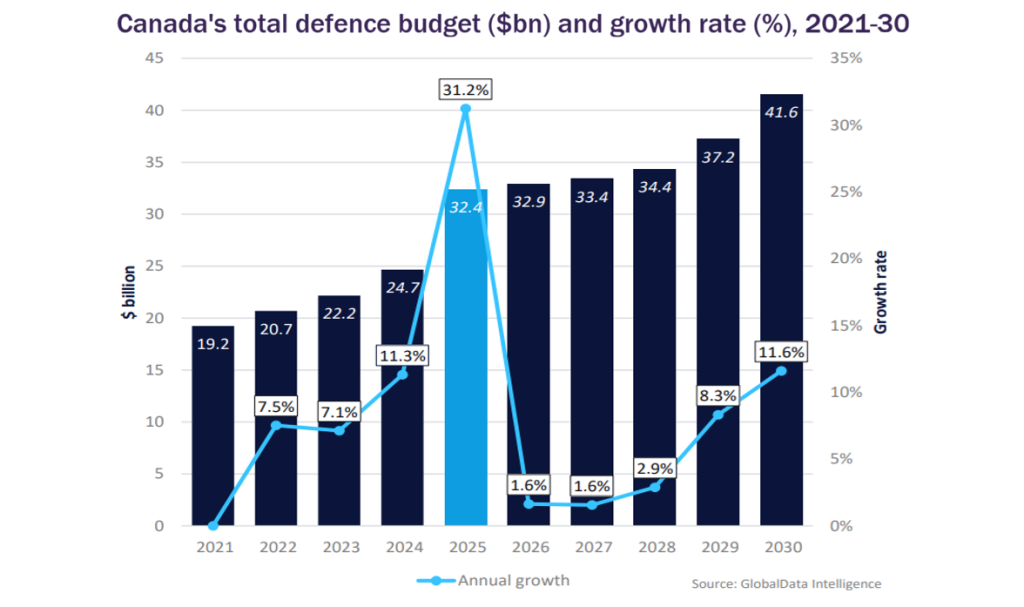
The Canadian defence budget climbed from $19.2bn in 2021 to $32.4bn in 2025. GlobalData projects further growth to reach $41.6bn by 2030. This upward trend is even more pronounced in defence acquisitions, which increased from approximately $3bn in 2021 to $11.9bn in 2025. Procurement spending is also expected to reach $17.7bn by 2030, reflecting a CAGR of 10.3%.
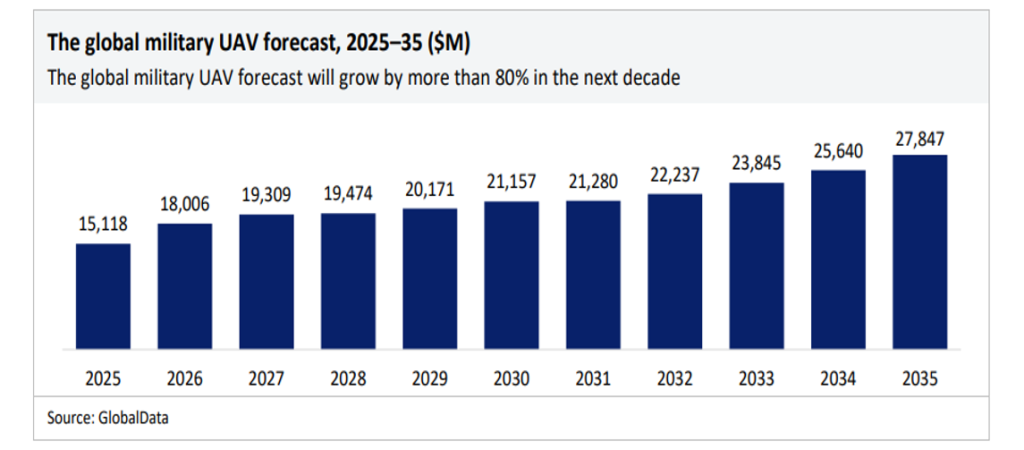
Overall, the total Canadian defence budget is projected to increase by approximately $8.7bn between 2026 and 2030, corresponding to an estimated average growth rate of around 6% per year.
In tandem, Canada met NATO’s 2% of GDP defence spending target for the first time since the Cold War, following a $9.3bn spike in expenditure in June 2025. This milestone was largely attributed to strategic investments in personnel, equipment, and infrastructure, underscoring Canada’s commitment to bolstering national defence and security while supporting domestic innovation. A key component of this shift is the increased investment in drone capabilities, supported by regulatory reforms aimed at enabling homegrown technological development.
Another notable investment came earlier this year, when Canadian Minister of National Defence David J McGuinty announced that the National Research Council of Canada (NRC) will invest more than $900m through Canada’s Defence Industrial Strategy (DIS), a $6.6bn framework aimed at driving domestic production and doubling Canada’s defence exports.
From the total fund, $500m will go towards advancing next-generation aerospace technologies and supporting the development of autonomous defence systems. Alberta is equipped to make a meaningful contribution to furthering the development of advanced aerospace technologies, with the University of Calgary and University of Alberta both having specialist departments that are researching unmanned aerial vehicles (UAVs) and robotics.
Aerospace technologies developed in Alberta could be used by the 3rd Canadian Division, which is significantly expanding its drone inventory as part of its effort to advance frontline capabilities. As of February 2026, the division operates 39 drones, with this figure projected to rise to more than 500 by the end of March 2027. Broader market trends reinforce this trajectory. GlobalData predicts that Canadian spending on tactical UAVs will nearly double from $8.6m in 2025 to $15m in 2030, while the market for medium-altitude long-endurance (MALE) UAVs is expected to grow from $124.1m in 2025 to $163.2m by 2035.
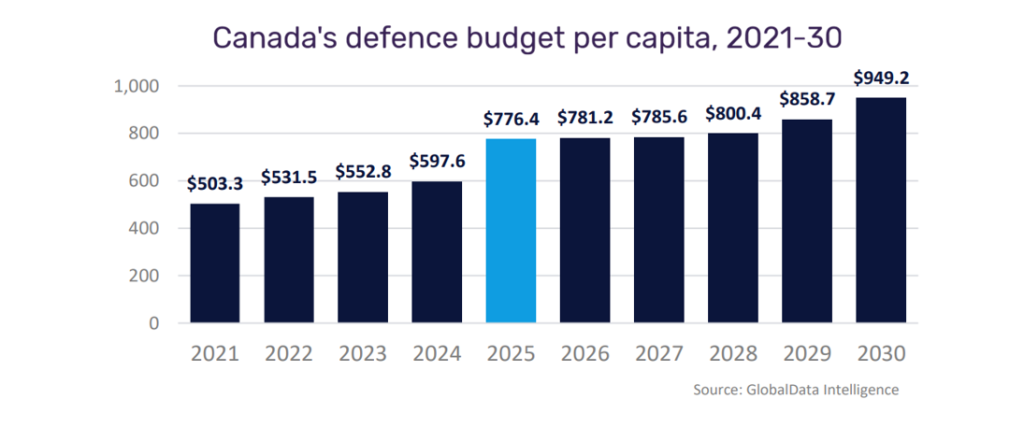
Alongside this, Canada’s defence budget is projected to steadily rise per capita to reach $949.2m by 2030. With exponential increases in defence spending also announced in Europe, Canada has extended its international defence cooperation through a bilateral agreement enabling participation in the EU’s Security Action for Europe (SAFE) regulation.
Through this agreement, Canada has become the first non-European country to join the €150bn defence programme. SAFE facilitates joint procurement among member states, with drone systems and counter-drone technologies listed as priority targets. Being part of the programme presents the potential for multiple export opportunities for Canadian manufacturers.
Accelerating drone innovations in Alberta
Given that many countries lack the resources to develop and scale unmanned and autonomous systems, defence departments are looking to other locations for solutions and closely following the innovation curve. In addition, many nations are dependent on international supply chains for essential components. However, Canada is building domestic innovation ecosystems capable of developing and commercialising innovative technologies in areas that include drones and AI, and Alberta is at the heart of this innovation.
Earlier this year, the Canadian Government announced a $241m investment in the National Research Council’s Industrial Research Assistance Program (NRC IRAP) to launch the Defence Industry Assist initiative. The funds will go towards supporting high-potential Canadian SMEs in developing defence and dual-use technologies, while providing the Department of National Defence with greater insight into scalable innovations. NRC IRAP supports nearly 10,000 SMEs annually through its national network, positioning the initiative as a key driver of Canadian innovation.
Within this context, the Canadian province of Alberta sits as one of North America’s most dynamic innovation ecosystems for drone and autonomous technologies. Alberta has long served as a testing ground for aerial equipment designed for harsh climates and remote operations, supported by its specialised testing ranges and access to NATO-affiliated facilities. For example, CBC reported earlier this year that the British military will return to southern Alberta to test advanced drones, underscoring the province’s global prominence in international UAV development.
A key site is the Foremost Unmanned Aircraft Systems Test Range in southern Alberta. Covering more than 2,400km2 of restricted airspace, it serves as a critical space for trialling UAVs. The site is also one of only two locations approved by Transport Canada for beyond visual line of sight (BVLOS) testing, providing SMEs with a distinct regulatory environment to develop modern drone technologies.
Federal backing for AI-enabled drone innovation is also expanding. The Canadian Government launched the Regional Artificial Intelligence Initiative (RAII) with a $1.16m investment to support Landing Zones Canada in developing and commercialising AI drone technologies in Alberta. This includes Canada’s GITPO Remotely Piloted Aircraft System (RPAS), a high-altitude platform that uses AI to autonomously return drones to base. The initiative underscores a broader policy objective to position both Canada and Alberta at the forefront of AI development for domestic and defence applications.
Other notable federal investments in Alberta include North Vector Dynamics’ recent $4.2m contracts targeting hypersonic research, counter-drone systems, and short-range air defence.
The next generation of technologies and talent are also being developed in Alberta through some notable institutions. Alberta’s Centre for Innovation and Research in Unmanned Systems at the Southern Alberta Institute of Technology (SAIT) is dedicated to furthering the development of remotely piloted aircraft systems (RPAS), as well as education and training.
Furthermore, the University of Alberta’s Centre for Applied Research in Defence and Dual-use Technologies (CARDD-Tech) is focused on innovations that can be deployed across a range of industries. CARDD-Tech conducts research in areas that include robotics and autonomous systems, AI, comms, sensing, and navigation, as well as advanced materials and manufacturing.
While at the University of Calgary, extensive research is underway into drones and robotics by the two specialist departments, Mechanical & Manufacturing Engineering, and Electrical & Software. The departments are anticipating the next generation of drones, with research into the potential applications of AI and machine learning.
Locations to optimise budgets for developing drones and AI in North America
With manufacturers around the world seeking to develop technologies as cost-effectively as possible, Alberta offers many advantages. Alberta’s combined federal-provincial business tax rate is approximately 23%, lower than in 44 US states. The province also benefits from a duty-free status for industrial manufacturers, the first of its kind in the G20, reducing costs on imported components and exported technologies. These advantages are complemented by strong logistics infrastructure, including two of Canada’s largest airports, integrated rail and intermodal networks, as well as a robust trucking network. All these factors enable efficient access to global markets for capital-intensive UAV and defence firms.
Alberta also maintains a strong industrial base in defence-related production, generating approximately $260m in electronics and supporting critical drone subsystems such as sensors, navigation, and communications. More than 25% of Canada’s geomatics, navigation, and GPS firms are based in Alberta, directly supporting UAV innovation and deployment.
Combined with the highest number of engineers per capita in North America, the province has a deep and highly skilled talent pool. With more than 170 aviation firms and a sector GDP of $6.3bn, Alberta provides both scale and expertise for sustained defence and autonomous systems investment.
“Strong defence essentially comes down to vertically integrated supply chains, which produce low-cost and highly effective solutions,” Thomas Kargacin, Senior Advisor of manufacturing, aerospace and defence investment at Invest Alberta.
“With this philosophy, Canada’s existing heavy industries, robust wealth of natural resources, advanced innovation ecosystem, and its proven ability to produce solutions for inhospitable environments make Canada a prime location to be one of the world’s super centres for defence production. Especially in Alberta,” adds Kargacin.
Dual-use tech and the ecosystem in Alberta
Drones’ uses in Alberta extend beyond defence and security. For example, Aerium Analytics has developed the RoBird, which is the world’s only drone system engineered to mimic the movements of a peregrine falcon. The remotely controlled drone flaps its wings like a bird to safely deter other birds from sites such as airports. RoBird provides safe, humane, and effective solutions to wildlife management.
While Alberta’s energy industry is the number one private investor and adopter of drone technologies in Canada. Drones are also being deployed in Canada’s mining industry. Deployment of drones enables the monitoring and mapping of industrial assets across vast distances to identify any areas that need further attention far more quickly and with greater precision than teams on the ground alone. In addition, the energy and mining industries are using drones to deter birds from sites to keep assets and wildlife both safe from harm, as well as minimising downtime.
“There are multiple other technologies in Alberta that have dual-use applications. There are Albertan companies that produce sensors used in mining and energy that are also being used to detect submarines in the Arctic,” says Kargacin.
“Software solutions for automated production can be leveraged for asset management. On the research side, the University of Alberta’s work on pressure vessels used in the oil and gas industry has applications for submarines,” he adds.
Albertan universities have been major contributors to the innovation pipeline in the province. The University of Alberta Aerial Robotics Group (UAARG) has developed UAV technologies for nearly two decades. In 2022, the University of Alberta’s Multimedia Research Centre partnered with Aerium Analytics on a $1m project to develop AI tools for specialised drones used in wildlife protection.
Elsewhere in the province, the Aerospace Innovation Hub at Calgary International Airport drives advances in space technologies, sustainable aviation, and novel drone systems. By bridging the gap between academia and industry, the hub fosters collaboration and provides clear pathways for commercialising innovations.
This combined institutional infrastructure builds on Alberta’s existing advantages to strongly position the province as a globally competitive ecosystem for drones and autonomous systems via R&D, innovation, and manufacturing.
To learn more about the variety of tech sectors in Alberta and how innovations are accelerating, download the document below.
