

Washington, DC has historically been characterised by government, policy, and professional services. However, this image captures only a portion of the city’s economic landscape. Throughout the District and the broader Washington metro area, a more specialised ecosystem is emerging, integrating fields such as life sciences, medical technology, digital health, and the policy frameworks that shape how new healthcare products are brought to market.
This convergence creates a unique health sciences cluster that blends scientific expertise with regulatory knowledge, clinical networks, data skills, and access to one of the most educated workforces in the US.
A life sciences ecosystem built on talent
For health-science companies, location is increasingly about access to people. Washington, DC, and its metro area provide a rich pool of specialised talent in the physical sciences, engineering, data, policy, and life sciences.
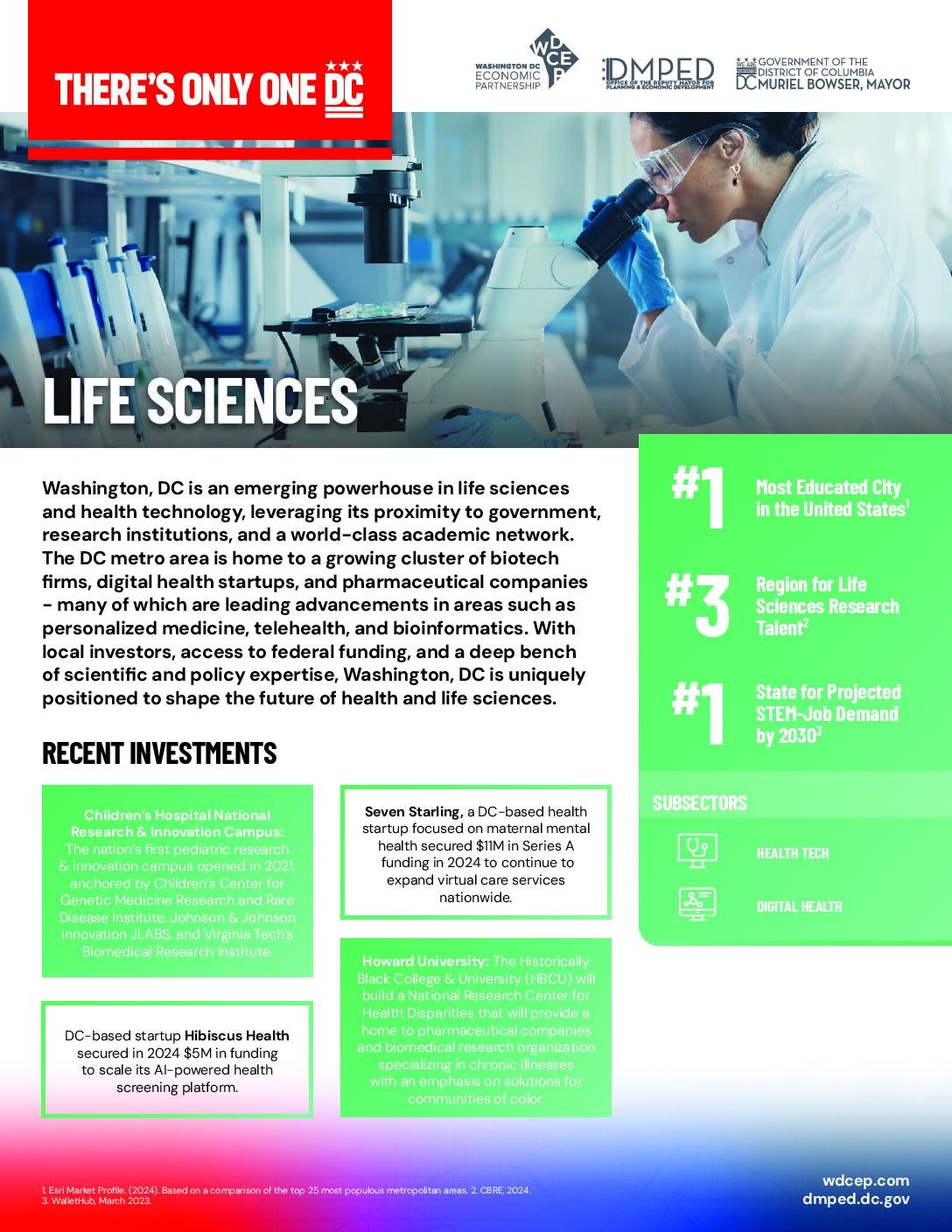
The Washington DC Economic Partnership (WDCEP) is a public-private partnership that supports economic development, providing market intelligence, business support and resources for companies looking to start, grow or relocate in Washington, DC. According to WDCEP’s industry cluster report, the Washington, DC metro area is home to four times the concentration of biological scientists as the US average, as well as high concentrations of natural sciences managers, life sciences and health tech roles, medical scientists, and biochemists and biophysicists. Furthermore, WDCEP ranks Washington, DC as the most educated city in the US, the wider region as the number three location for life sciences research talent, and DC as the number one state for projected STEM-job demand by 2030.
In this region, academic institutions, hospitals and federal agencies create a steady exchange of talent and ideas. The Children’s Hospital National Research & Innovation Campus, which opened in 2021, is described by WDCEP as the nation’s first paediatric research and innovation campus. It is anchored by the Children’s Center for Genetic Medicine Research and Rare Disease Institute, Johnson & Johnson Innovation JLABS, and Virginia Tech’s Biomedical Research Institute.
Looking forward, there is Howard University’s proposed National Research Center for Health Disparities. This Historically Black College and University will establish a facility to host pharmaceutical companies and biomedical research organisations focusing on chronic illnesses, with a particular focus on solutions for communities of colour.
New opportunities in medtech and digital health
The region’s company base includes major international businesses, specialist medical device firms, digital health platforms and early-stage technology companies. WDCEP’s major employer list points to the breadth of the cluster, spanning CaryHealth, Danaher, Lilly, GRAIL, United Therapeutics and Vanda Pharmaceuticals.
Danaher Corporation, headquartered in Washington, DC, is one of the most prominent examples. The company describes itself as a global life sciences and diagnostics innovator, with businesses operating in 50 countries and at 700 locations worldwide. Its presence provides the District with a major corporate reference point in a sector where scientific instrumentation, diagnostics and biotechnology platforms are central to healthcare innovation.
Other companies, such as Medcura, show the region’s appeal for focused medical technology development. Medcura is developing hemostatic technologies designed to control bleeding in surgical and trauma settings. Its LifeGel technology received US Food and Drug Administration (FDA) Breakthrough Device Designation for controlling bleeding during surgery in procedures where swelling cannot be tolerated.
GMED North America is a key example of a company in the region that helps healthcare innovators navigate quality, certification, and market access. GMED describes itself as a certification and conformity assessment partner for the medical device industry, with services covering CE marking, quality management system certification, and the Medical Device Single Audit Program.
Digital health is also expanding. CaryHealth, founded in 2017 by pharmacists and technologists, is building personalised digital healthcare experiences at scale. WDCEP notes that the DC-based company ranked #82 on the 2024 Inc. 5000 list of the fastest-growing businesses, as well as #2 in artificial intelligence and #1 in DC. BusinessWire reported that the ranking reflected three-year revenue growth of 3,752%.
The wider healthtech base also includes companies such as GRAIL, Optum and Limber Health. GRAIL is focused on early cancer detection, Optum brings together healthcare services, data and technology capabilities, and Limber Health provides digital musculoskeletal care tools for therapy providers and patients.
Recent funding activity suggests that investors are responding to Washington, DC’s health technology proposition. Seven Starling, a DC-based health start-up focused on maternal mental health, secured $11m in Series A funding in 2024 to expand virtual care services nationwide. Hibiscus Health, another DC-based start-up, secured $5m in 2024 to scale its AI-powered health screening platform.
Proximity to federal health agencies in DC
Washington, DC’s health sciences story cannot be separated from its institutional geography. For companies developing medical devices, diagnostics, digital health tools or healthcare data products, proximity to regulators, standards bodies, and research funders can shape their business development strategy.
The FDA’s headquarters is on the White Oak campus in Silver Spring, Maryland, with ten office buildings and four laboratory buildings, totalling 3.1 million rentable square feet. The National Institutes of Health (NIH) is headquartered in Bethesda, Maryland, and comprises 27 institutes and centres. The National Institute of Standards and Technology (NIST), based in Gaithersburg, Maryland, further enhances standards, measurement science, and technical infrastructure. NIST notes that its Gaithersburg campus employs more than 2,800 federal staff and hosts 3,200 visiting associates.
For companies, this means that the local ecosystem is unusually fluent in the language of regulatory pathways, public health priorities, scientific standards and federal funding. That expertise is valuable for firms developing products that must move from laboratory validation to clinical adoption and market access.
Why Washington, DC is becoming a health sciences hub
The strongest clusters form where specialist talent, institutions and market access combine to create momentum. Washington, DC has reached that point in life sciences and health technology, with a strong workforce, federal and academic assets, and a company base that extends from global life sciences leaders to specialist medtech firms and digital health start-ups. Beyond talent and proximity, Washington, DC offers practical support for companies looking to grow in the District. WDCEP provides maps, publications, information on available incentives, executive testimonials and access to the Washington, DC Global Soft Landing programme, helping businesses understand the market and connect with the right local resources.
Washington, DC, is moving beyond its traditional identity as a centre of government and professional services and becoming fertile ground for health-science companies that need more than laboratory space. They need talent, partnerships, policy insight and a place where ideas can move closer to real-world adoption.
To find out more, download the whitepaper below.
