
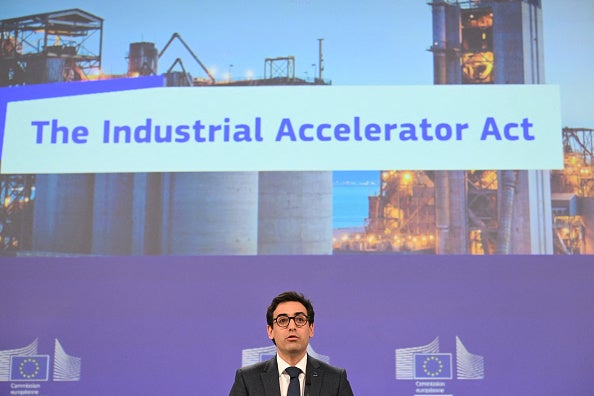
The latest draft of the EU’s Industrial Accelerator Act (IAA) outlines policies that will shape how the bloc attracts foreign direct investment (FDI) for the foreseeable future.
The policy seeks to protect the bloc’s green tech industry – a sector that China has come to dominate in recent years – and address the oversupply of Chinese goods in the market, which has been exacerbated by the proliferation of US tariffs.

Discover B2B Marketing That Performs
Combine business intelligence and editorial excellence to reach engaged professionals across 36 leading media platforms.
Analysts note that by pursuing an industrial strategy centred on protecting strategic sectors and local production within the bloc, the EU is catching up with other economic actors such as the US and China, which have long implemented similar policies.
“The introduction of local content requirements is a bit inescapable,” Davide Oneglia, director of European and global macroeconomics at TS Lombard, tells Investment Monitor. “It is not something Europe would have done if not for the fact that the world is going in that direction anyway, and they are essentially catching up.”
The China threat
Leaders have been clear about the threat China poses to Europe’s competitiveness in strategic sectors and to the bloc’s industrial base.
“If we do nothing then it is quite clear that very soon 100% of clean technology will be produced in China,” Stéphane Séjourné, the EU’s Executive Vice-President for Prosperity and Industrial Strategy, said in justifying the IAA.
The bloc’s trade deficit with China has continued to grow over the past year, accentuated by a rise in US tariffs that have reshaped the global flow of goods.
According to data published by Eurostat in February, Chinese imports to the EU grew by 6.3% in 2025, while EU exports to China declined 6.5%, widening the trade deficit to €359.3bn ($414.8bn), compared to €304.5bn in 2024.
China has also significantly grown its green tech sector over the past few years, complicating the EU’s ambitions in the space. In 2024, the country’s level of wind and solar construction was double the rest of the world’s combined.
The country’s competitiveness in the electric vehicle sector, for example, has been a cause for conflict for European carmakers, which claim that the lower-than-market rate prices being offered by these companies are only possible because of unfair trade practices. This has led to anti-subsidy probes from the EU.
“There is definitely a case for this. Especially considering China has done similar things in the past as well. It doesn’t have an open procurement market. It asks us for joint ventures for tech exchange. It has very strong investment conditions,” Philipp Lausberg, senior policy analyst at the European policy centre, tells Investment Monitor.
In the past, these practices might have been more scrutinised by trade bodies like the World Trade Organistion. However, Oneglia notes that it has become more accepted that countries will have to take measures to protect their manufacturing bases as China becomes more competitive. “It is a brave new world,” he says.
The difficulty now is pursuing an industrial strategy at a moment where trade negotiations are rife with unreasonable investment demands, tariffs and heightened uncertainty.
“The EU has every right to react. The question is how to do that, without getting into conflict with partners, destroy trade relationships and not push up prices too much,” Lausberg says.
What is in the IAA?
The IAA has a wide remit that covers public procurement, local production laws, low-carbon requirements, and more. The biggest change in FDI screenings concerns tighter measures on country of origin rules, which are mainly aimed at China.
The EU can screen any foreign investment project in a strategic sector worth more than €100m, where the investor country controls at least 40% of that sector’s global manufacturing capacity. The foreign entity cannot hold a majority stake in an EU company, it must employ mostly European workers and license its intellectual property for the benefit for the bloc.
In 2024, the third-largest source of FDI in Europe was China, with €10.6bn (84.18bn yuan) of investments, according to GlobalData’s FDI Trends in Europe (2025) report.
The IAA also establishes local production laws and low-carbon requirements for products bought through public procurement processes, or for those receiving manufacturing subsidies. These requirements affect strategic sectors including batteries, solar and wind energy, hydrogen manufacturing and nuclear power plants. They may vary by sector, depending on whether the intention is to protect an industry the EU already has a lead in, or to take back a smaller share of an industry led by China.
Pressure point
There are still points of contention in the IAA to be figured out. The biggest one so far concerns what qualifies as local production under the Made in Europe provision, which aims to direct public procurement contracts to EU companies. It is unclear whether traditional allies like the US or the UK would be categorised as “trusted partners”, a status that would exempt countries from some of these requirements.
Another aspect of the IAA that may get weakened as the policy goes through more approval processes is how much power it gives Brussels to block individual transactions.
“Member states might not be happy with some of the details about empowering the commission quite a lot,” Lausberg says.
The proposal says the Commission may decide on the viability of a project if its value exceeds €1bn. There are past FDI projects that would have likely been reviewed under such a policy, such as Chinese battery manufacturer CATL’s €7.3bn factory in Hungary or AESC’s (a subsidiary of Chinese multinational Envision Group) €1.3bn electric battery plant in Douia, France.
The proposal will now be reviewed by the European Parliament, where legislators can propose amendments.



